Citibank
$1Billion for Racial Equity
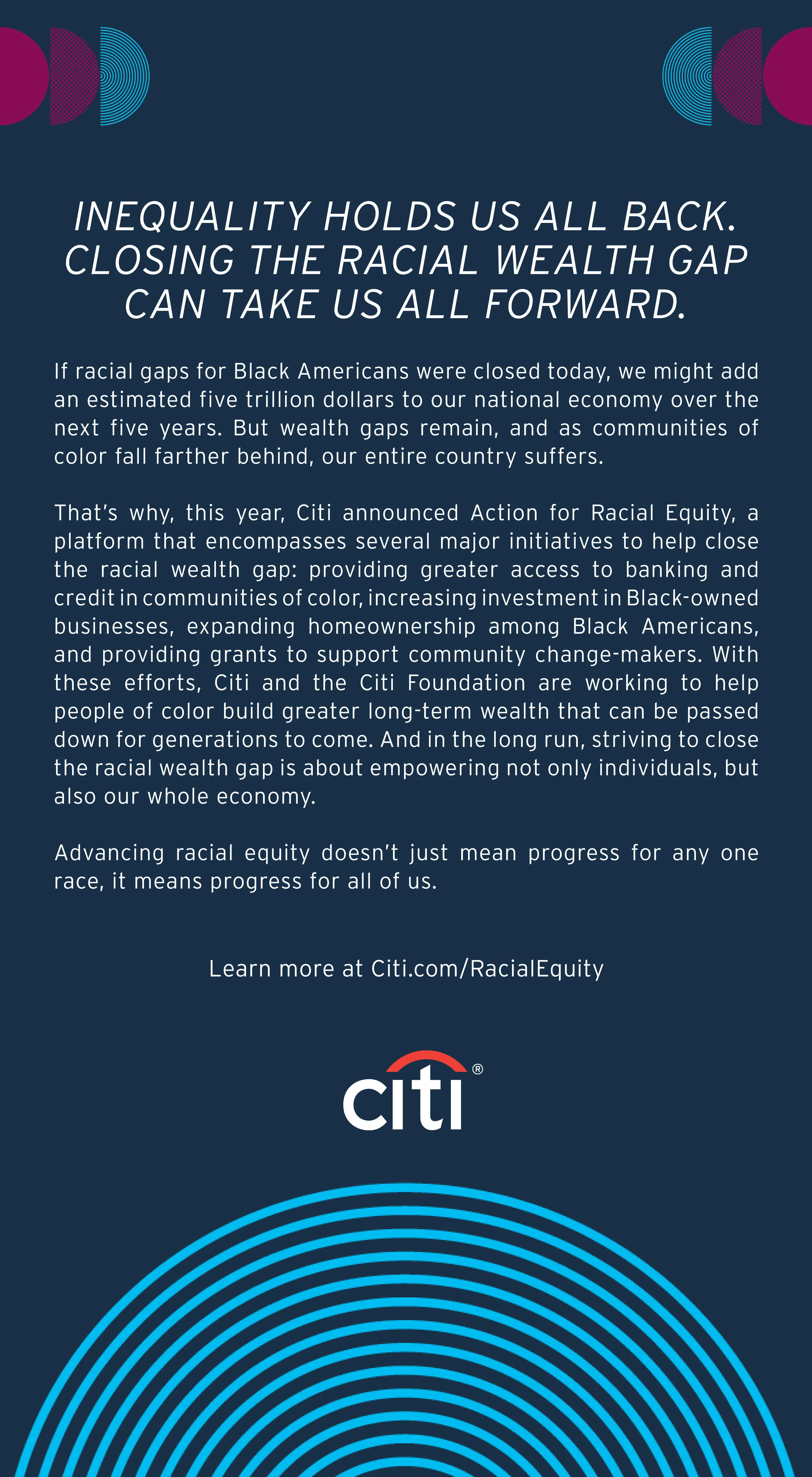
As part of Citibank’s worldwide “For the Love of Progress” campaign for major philanthropic efforts, they announced a billion-dollar initiative to help bridge the racial wealth gap in America. This 360 campaign highlights key efforts by Citi to address homeownership, entrepreneurship, banking, and credit among people of color.
Produced during the global pandemic and social-distancing.
Campaign concept · Broadcast & OLV Scripts · Print & OOH
VO:
There’s a racial equity problem in America.
One thing that we can do to solve it is invest more in people of color.
If, 20 years ago, Black entrepreneurs were provided more lending, the U.S. might have generated up to thirteen trillion more dollars in business revenue, and created over six million new jobs each year.
What closing the racial wealth gap really does,
is create greater opportunity for the whole country.
With Action for Racial Equity, Citi is working to increase investment in Black-owned businesses.
Learn more at citi.com/RacialEquity.
VO:
Over the last 20 years, the U.S. economy might have gained up to sixteen trillion dollars if the racial wealth gap didn’t exist.
But it does. And it needs to end.
With Action for Racial Equity, Citi is working to:
Provide greater access to banking and credit in communities of color.
Increase investment in Black-owned businesses.
And expand homeownership among Black Americans.
Because closing the racial wealth gap creates a better, more prosperous future for everyone.
Learn more about Citi’s Action for Racial Equity at citi.com/RacialEquity
VO:
Right now, the average white household’s wealth is ten times that of Black families.
If we try closing this racial wealth gap today,
we, as a country, could generate up to five trillion more dollars in just five years.
With Action for Racial Equity, Citi is working to increase access to banking and credit in communities of color.
Because striving for racial equity is about creating a brighter financial future for everyone.
Learn more at citi.com/RacialEquity.
New York Times Print